
What Is Net Unrealized Appreciation (NUA), and Should You Use It on Company Stock?
Net Unrealized Appreciation, or NUA, is a tax rule that lets you move highly appreciated company stock out of your 401(k) and pay ordinary income tax only on what the shares originally cost, while the growth gets taxed later at lower long-term capital gains rates. For a senior tech executive who has watched company stock inside a retirement plan multiply over a decade, that difference can be worth a lot of money. It is not the right move for everyone, and the rules are strict, so the honest answer is that NUA is a powerful tool that only works when the numbers and the timing line up.
What does NUA actually mean, in plain English?
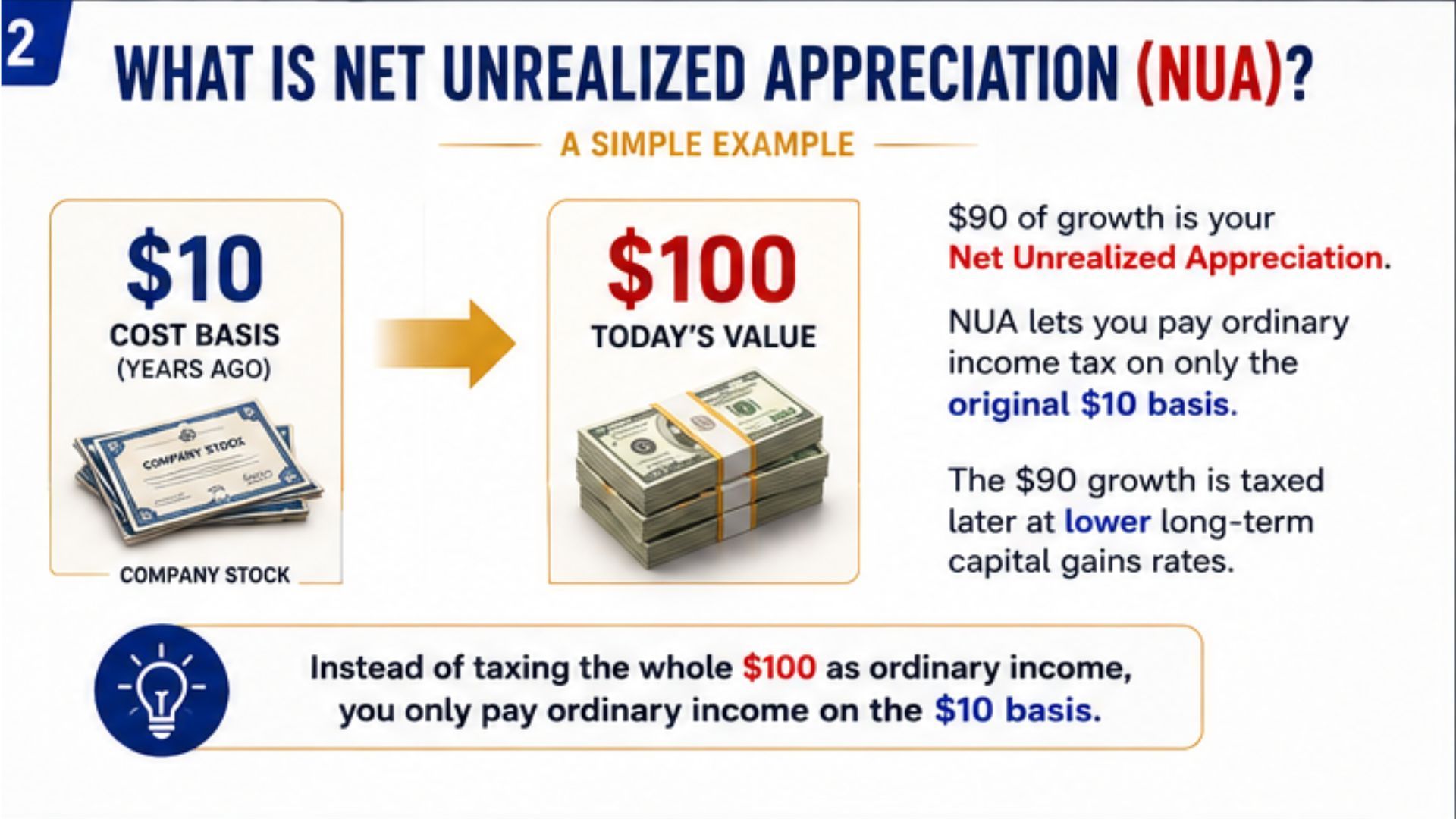
Let me define the term the way I would to a friend across the kitchen table. Net Unrealized Appreciation is simply the growth on company stock that is sitting inside your employer retirement plan. If your company put shares into your 401(k) years ago at ten dollars a share, and today those same shares are worth a hundred dollars, then ninety dollars per share is your net unrealized appreciation. The ten dollars is your cost basis, which is tax-speak for what you paid, and the ninety dollars is the appreciation you have not been taxed on yet because it is still tucked inside the plan.
Normally, when money comes out of a 401(k), all of it is taxed as ordinary income, which for a high earner is the most expensive kind of tax there is. The NUA rules carve out an exception, but only for actual employer stock held in the plan. When you use the strategy, you pay ordinary income tax on the cost basis, the small original number, in the year you take the shares out. The big number, the appreciation, does not get taxed as ordinary income at all. Instead it waits and is taxed at long-term capital gains rates when you eventually sell the shares. That is the whole game: turning a large chunk of what would have been ordinary income into lower-taxed capital gains.
How much can NUA really save a high earner?
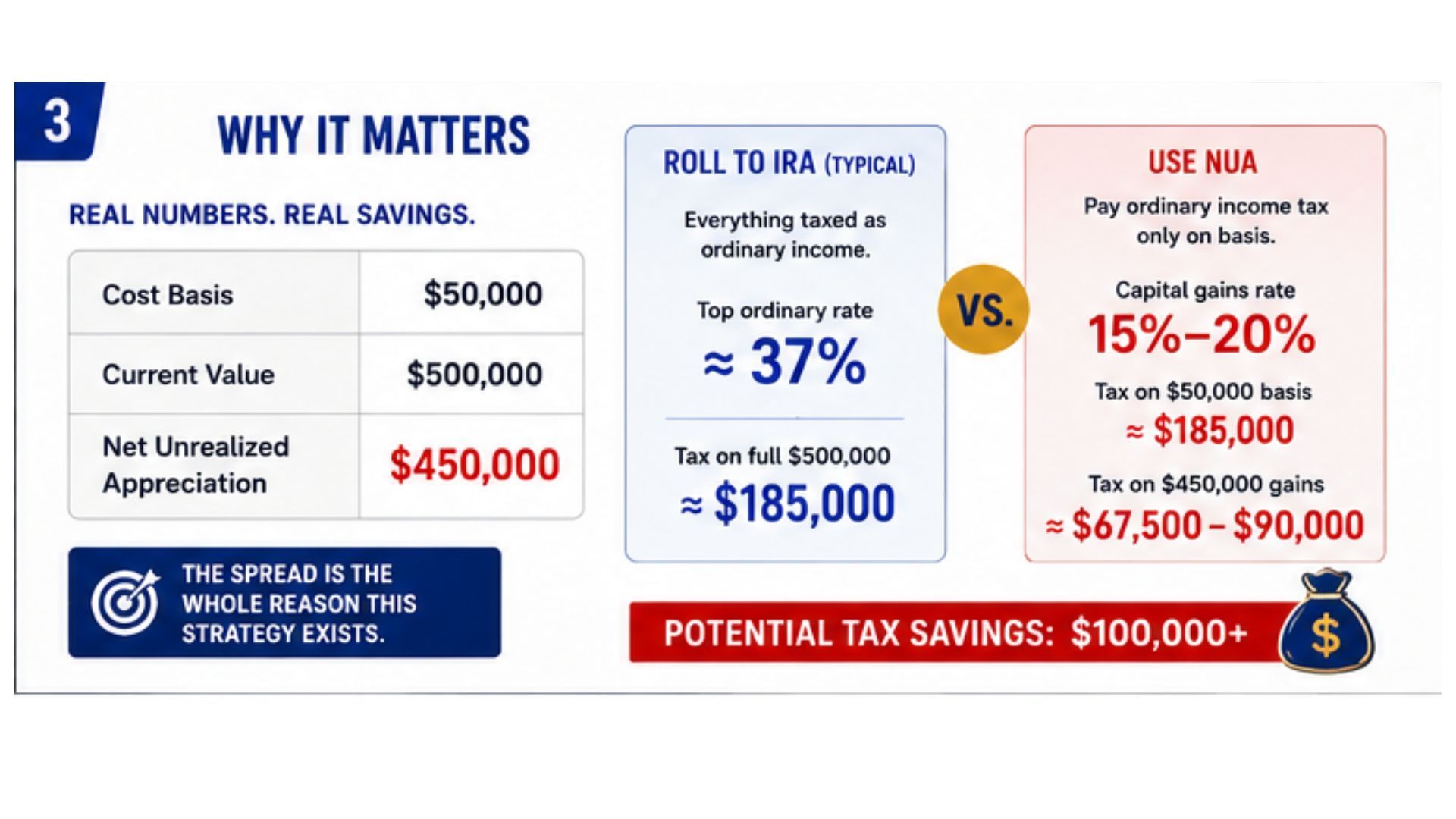
Here is where a real number makes it click. Say you have company stock in your 401(k) with a cost basis of fifty thousand dollars that is now worth five hundred thousand dollars. Your net unrealized appreciation is four hundred fifty thousand dollars. If you roll that whole account into an IRA the way most people do, every dollar you later withdraw comes out as ordinary income. At the top federal brackets a high-earning tech executive can be looking at thirty-seven percent on that money, plus state tax in some places.
With the NUA strategy, you instead take the shares out in kind and pay ordinary income tax on only the fifty thousand dollar basis. The four hundred fifty thousand dollars of appreciation is then taxed at long-term capital gains rates when you sell, which top out at twenty percent federally in 2026, and can be fifteen percent or even zero percent for gains that fall in the lower brackets. The spread between paying thirty-seven percent and paying fifteen or twenty percent on nearly half a million dollars is exactly why this strategy exists. As I tell clients, the tax code rarely hands you a discount this size, so when it does, it is worth slowing down to see whether you qualify.
What are the rules you have to follow to qualify?
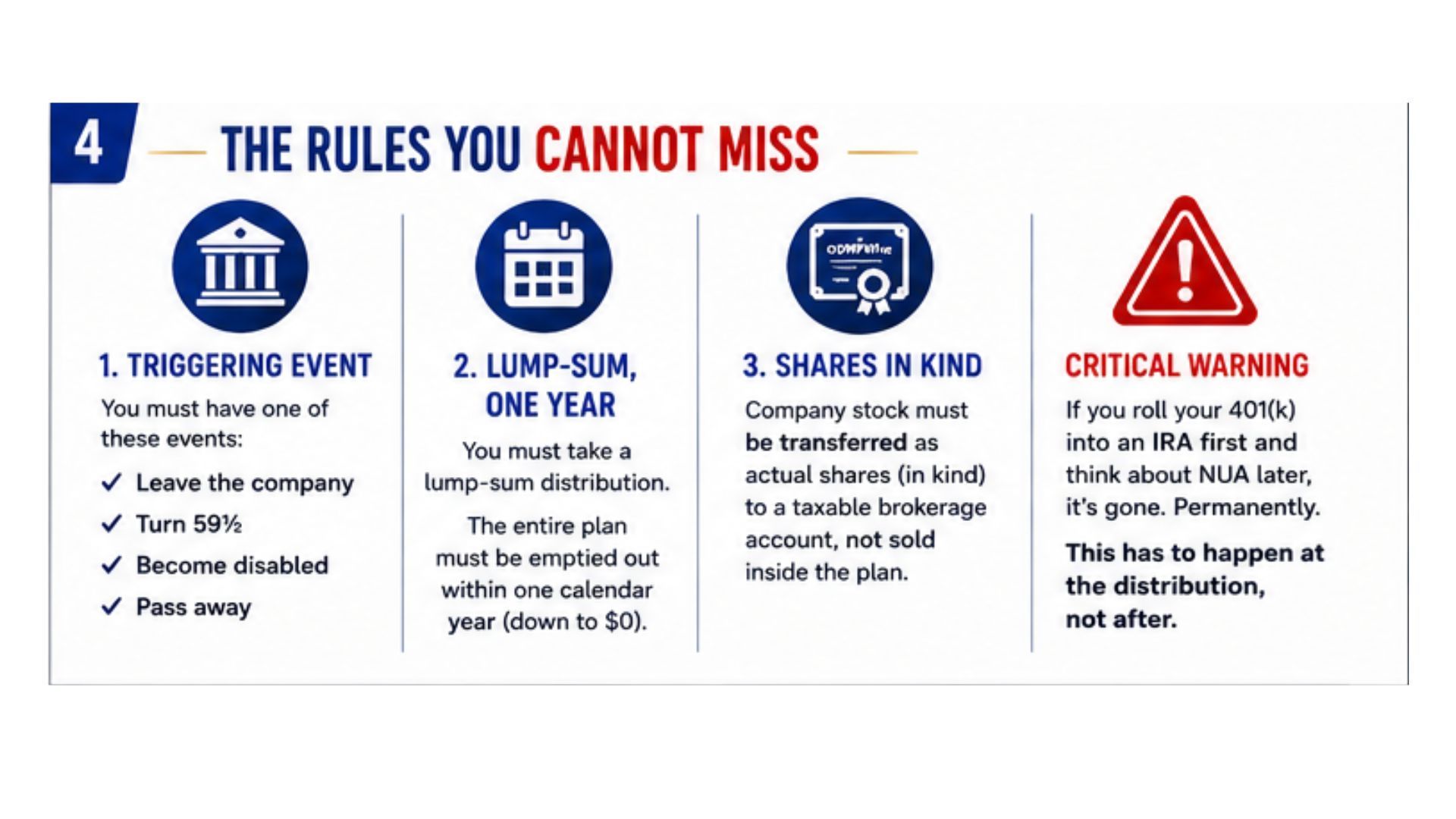
This is where people get tripped up, because the IRS is strict about all of it, and missing one step can blow up the whole benefit. There are three moving parts that have to be right.
First, you need a triggering event. NUA is only available after one of four things happens: you separate from service (you leave the company, retire, or get laid off), you reach age fifty-nine and a half, you become disabled, or you pass away. For most Victoria-stage executives, leaving the company or turning fifty-nine and a half is the trigger that matters.
Second, you have to take a lump-sum distribution. That is a specific tax term, not just a big withdrawal. It means the entire balance of the plan has to come out within a single calendar year, leaving the account at zero by December 31 of that year. The company stock gets distributed in kind, meaning the actual shares move to a taxable brokerage account, while the rest of the plan can be rolled to an IRA. Get the timing wrong and split it across two years, and the distribution no longer counts as a qualifying lump sum.
Third, the shares have to move as shares. The stock must be distributed in kind, not sold inside the plan and sent to you as cash. Once it is sold inside the 401(k), the NUA opportunity is gone. And there is one more trap worth burning into memory: if you roll your 401(k) into an IRA first and then think about NUA later, you have permanently lost the chance on those shares. The strategy has to happen at the distribution, not after.
When does NUA make sense, and when does it not?
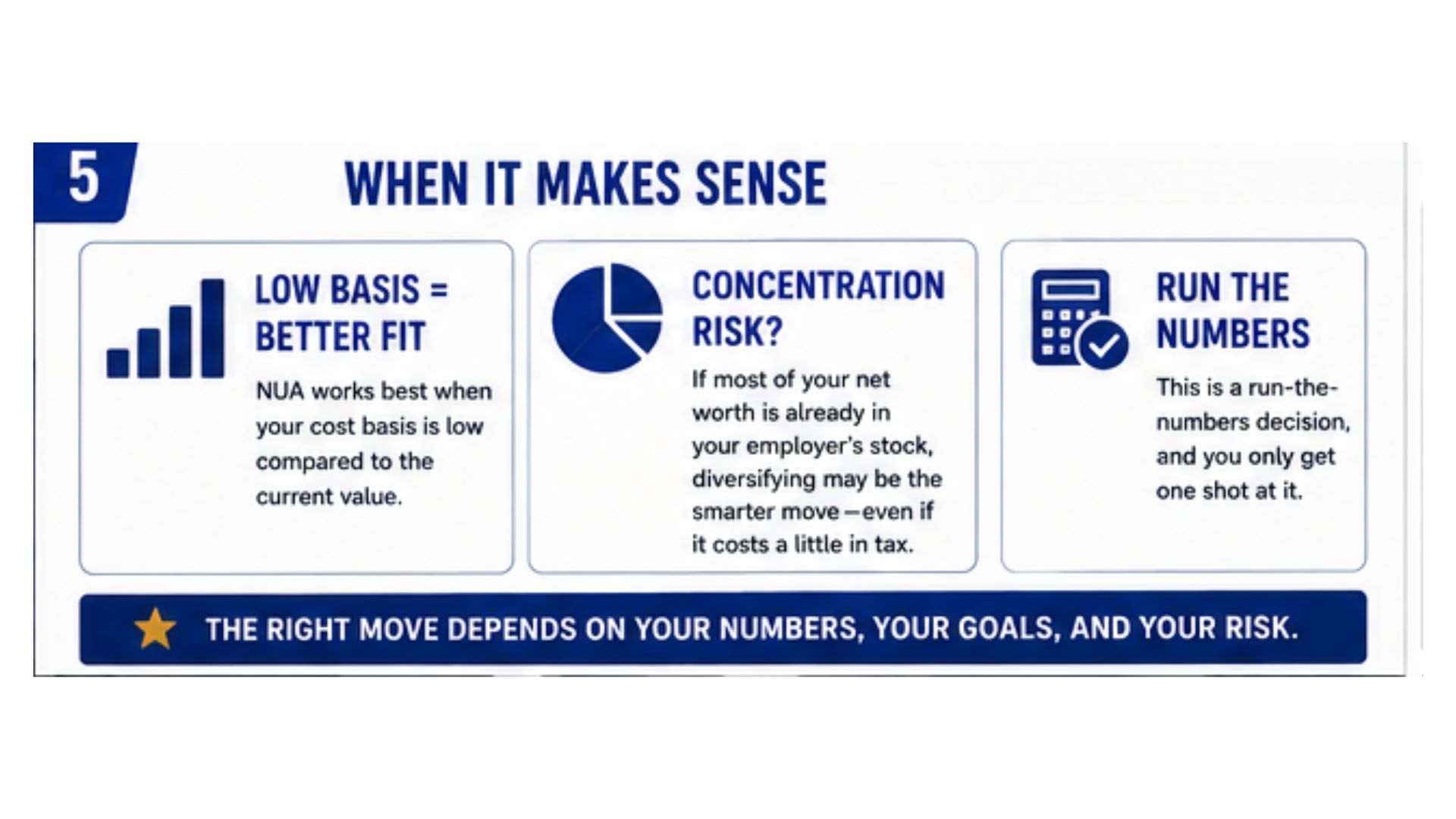
NUA is not automatically the winner, and I want to be straight about that. The strategy works best when your cost basis is low relative to the current value, because you are paying ordinary income tax on that basis right now, up front, in a single year. If the basis is large, that upfront tax bill can be painful and can even push you into a higher bracket for the year, which eats into the benefit. A rough rule many planners use is that the lower the basis as a percentage of the total value, the more attractive NUA becomes.
Your age and time horizon matter too. If you are younger and the shares will keep growing for decades inside a tax-advantaged account, the value of tax deferral in an IRA can rival or beat the NUA benefit. There is also concentration risk to weigh, which is a real issue for tech executives whose net worth is already tilted toward one employer. Sometimes the smarter financial move is to diversify out of a big single-stock position even if it costs a little in taxes, because having half your retirement riding on one company is its own kind of danger. NUA and diversification can work together, but they can also pull against each other, and that tension is exactly the kind of thing worth modeling before you act. This is genuinely a run-the-numbers decision, not a rule of thumb, and it is one you do not get a second chance at once the distribution happens.
Key takeaways
- NUA lets you pay ordinary income tax on only the cost basis of company stock in your 401(k), while the appreciation is taxed later at lower long-term capital gains rates.
- It applies only to actual employer stock held inside an employer retirement plan, not to other investments in the account.
- You must have a triggering event (separation from service, age fifty-nine and a half, disability, or death), take a qualifying lump-sum distribution within one calendar year, and move the shares in kind.
- Rolling your 401(k) to an IRA first permanently destroys the NUA opportunity on those shares.
- The strategy is most attractive when the cost basis is low relative to the current value, but concentration risk and your time horizon can change the math.
- This is a one-shot, run-the-numbers decision best made with a tax and financial planning professional before you pull the trigger.
Frequently asked questions
What kind of stock qualifies for NUA treatment? Only actual shares of your employer's stock held inside an employer-sponsored retirement plan, such as a 401(k) or an ESOP. Mutual funds, index funds, and other investments in the plan do not qualify, and stock held in an IRA does not qualify.
Do I pay tax on the appreciation right away when I take the shares out? No. You pay ordinary income tax only on the cost basis in the year you take the distribution. The net unrealized appreciation is not taxed until you actually sell the shares, and at that point it is taxed at long-term capital gains rates regardless of how long you held them.
Can I still use NUA if I already rolled my 401(k) into an IRA? No. Once the company stock has been rolled into an IRA, the NUA opportunity on those shares is permanently lost. The strategy has to be executed at the time of the qualifying distribution, which is why the sequence of steps matters so much.
Is there an early withdrawal penalty on an NUA distribution? If you are under age fifty-nine and a half when you take the shares, the ten percent early withdrawal penalty can apply to the cost basis portion, since that is the part treated as a taxable distribution. This is one more reason the timing and your age at distribution deserve careful attention.
Does the NUA appreciation ever get the step-up in basis at death? The NUA portion does not receive a step-up in basis at death the way ordinary appreciated securities do. Any additional growth on the shares after they leave the plan can qualify, but the original NUA amount generally does not. This is a detail worth reviewing with an estate and tax professional.
Should I always take company stock out using NUA? Not always. NUA shines when your cost basis is low relative to the current value, but a high basis, a long time horizon, or a need to diversify away from a concentrated position can all tilt the answer the other way. It is a case-by-case decision.
About Jeff Kikel
Jeff Kikel is the founder of Freedom Day Wealth, a fee-based wealth and retirement planning firm that helps senior professionals and executives turn a career's worth of equity compensation and savings into a confident, well-planned retirement. Jeff writes and speaks in plain language because he believes people make better decisions when they actually understand what is happening with their money. His approach is simple: explain the tradeoffs honestly, keep the focus on the long term, and always circle back to what you should actually do next.
If you are within about ten years of retirement and sitting on a pile of company stock, RSUs, or options and wondering how to bring it all home without handing an unnecessary share to taxes, Freedom Day Wealth can help you build a plan. You can learn more at
www.FreedomDayWealth.com.
This article is for educational purposes only and is not investment, tax, or legal advice. Every situation is different, and the rules referenced here can change. Please consult a qualified financial, tax, or legal professional before making decisions about your own company stock or retirement accounts.
Sources
- Kitces: 401(k) Net Unrealized Appreciation (NUA) Rules And Caveats
- Blue Chip Partners: The Executive's Guide to Net Unrealized Appreciation (NUA) in 2026
- Wealth Enhancement Group: Net Unrealized Appreciation: A Guide to NUA Strategies