The Mega Backdoor Roth: Is It Worth It for High Earners?
A mega backdoor Roth lets you put after-tax dollars into your 401(k) beyond the normal employee deferral limit, then convert them to Roth so they grow tax-free for the rest of your life. In 2026, the employee deferral limit is $24,500, but the total that can flow into your 401(k) from all sources is $72,000, and that gap is what this strategy fills. It is worth it if your plan actually allows it, you have already funded the basics, and you have cash left over that would otherwise go into a taxable brokerage account.
What is a mega backdoor Roth, in plain English?
Let me define the terms first, because this strategy is one where the name does more harm than good. A regular backdoor Roth is a small maneuver involving an IRA, worth about $7,500 a year in 2026. A mega backdoor Roth happens inside your work 401(k), and it can be worth five or six times that amount. Same word, completely different plumbing.
Here is the basic idea. Most people think of a 401(k) as having one limit, the amount they can defer out of their paycheck. In 2026, that number, which the code calls the 402(g) limit, is $24,500, plus $8,000 more if you are 50 or older, or $11,250 if you happen to be 60, 61, 62, or 63. But a second, much larger limit sits above it. Internal Revenue Code Section 415(c) caps the total of everything that goes into your 401(k) in a year, meaning your own deferrals plus the company match plus any profit sharing plus any after-tax money, at $72,000 for 2026. Catch-up contributions sit on top of that number rather than inside it, so a 50-year-old is really working with $80,000 of total room.
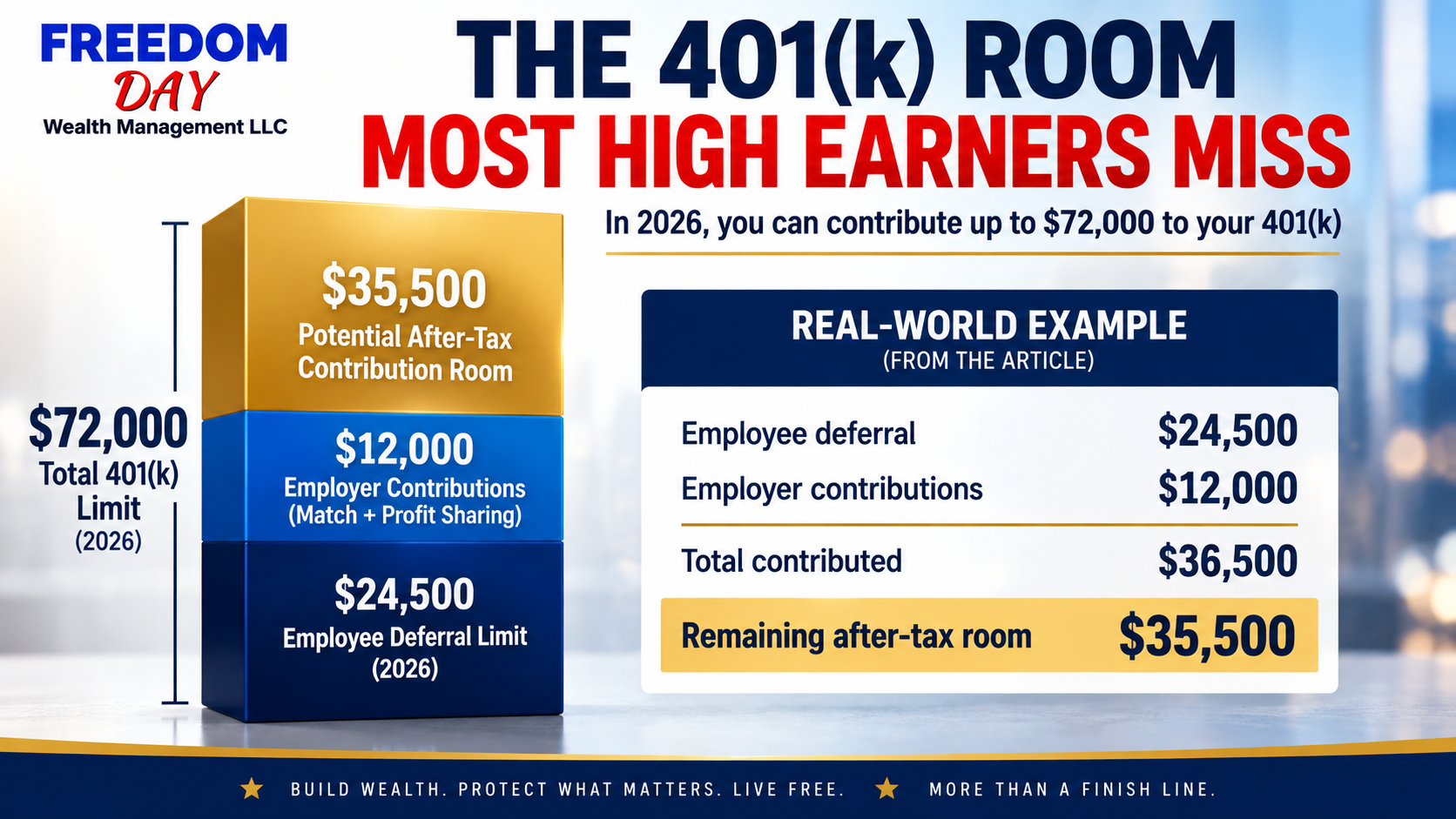
Now do the arithmetic that makes this interesting. Suppose you defer the full $24,500 and your employer contributes $12,000 through the match and profit sharing. That is $36,500 of the $72,000 used, which leaves $35,500 of unused room. The mega backdoor Roth is simply filling that remaining room with after-tax contributions from your paycheck, then immediately converting those after-tax dollars into Roth money. Because you already paid tax on them, the conversion itself generally costs you nothing, and from that moment forward the growth is tax-free.
That is the whole thing. It sounds exotic, but it is really just using a part of your 401(k) that most people never notice is there.
How does the money actually move?
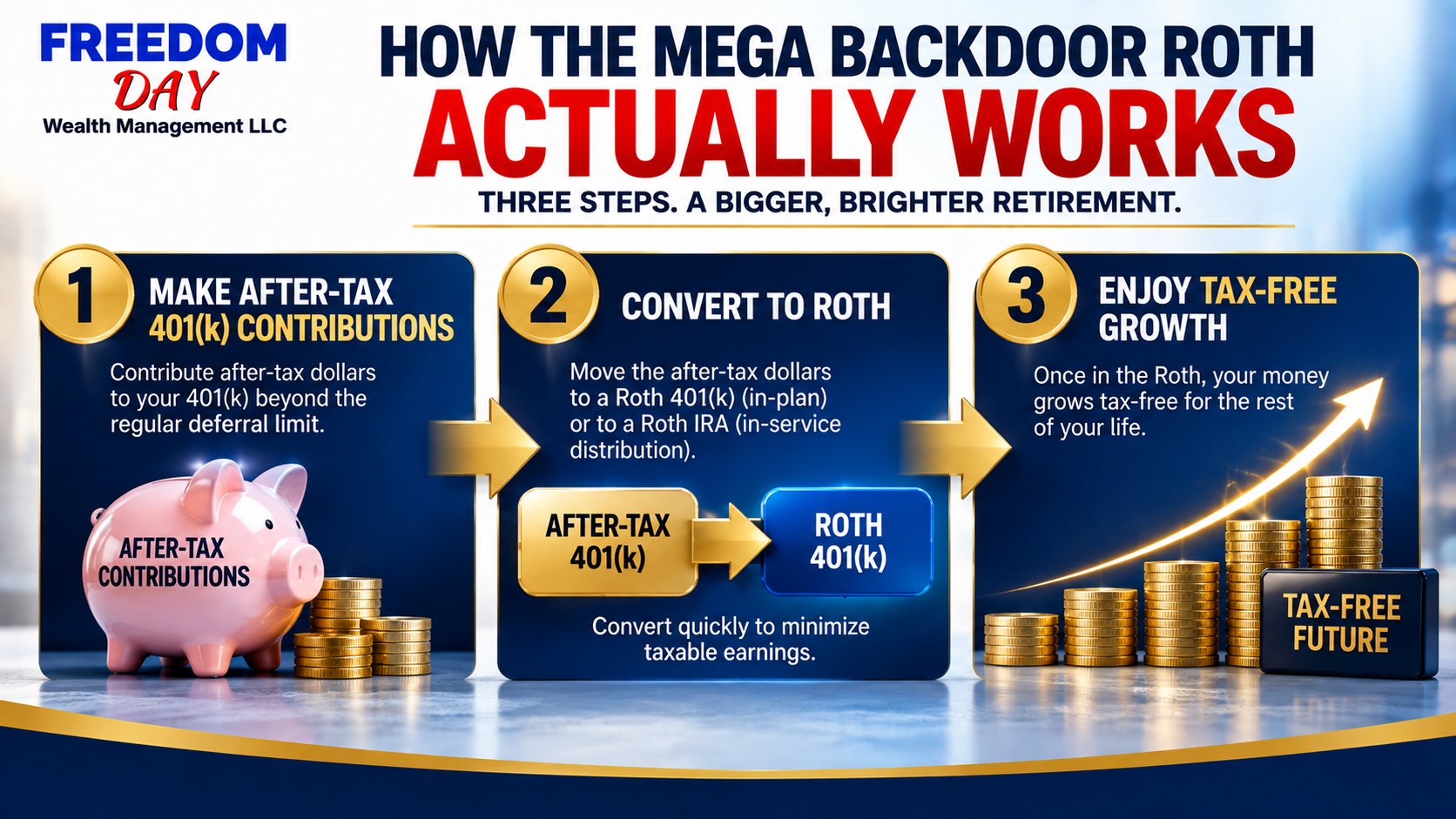
The mechanics matter, because this is where the strategy either works beautifully or creates a headache. There are three steps, and each one depends on your specific plan document.
.
Does your plan even allow it?
This is the first question to ask, and for a lot of people it ends the conversation right there. The mega backdoor Roth is not a tax loophole you can elect on your own. It is a plan design feature, and your employer has to have built it in.
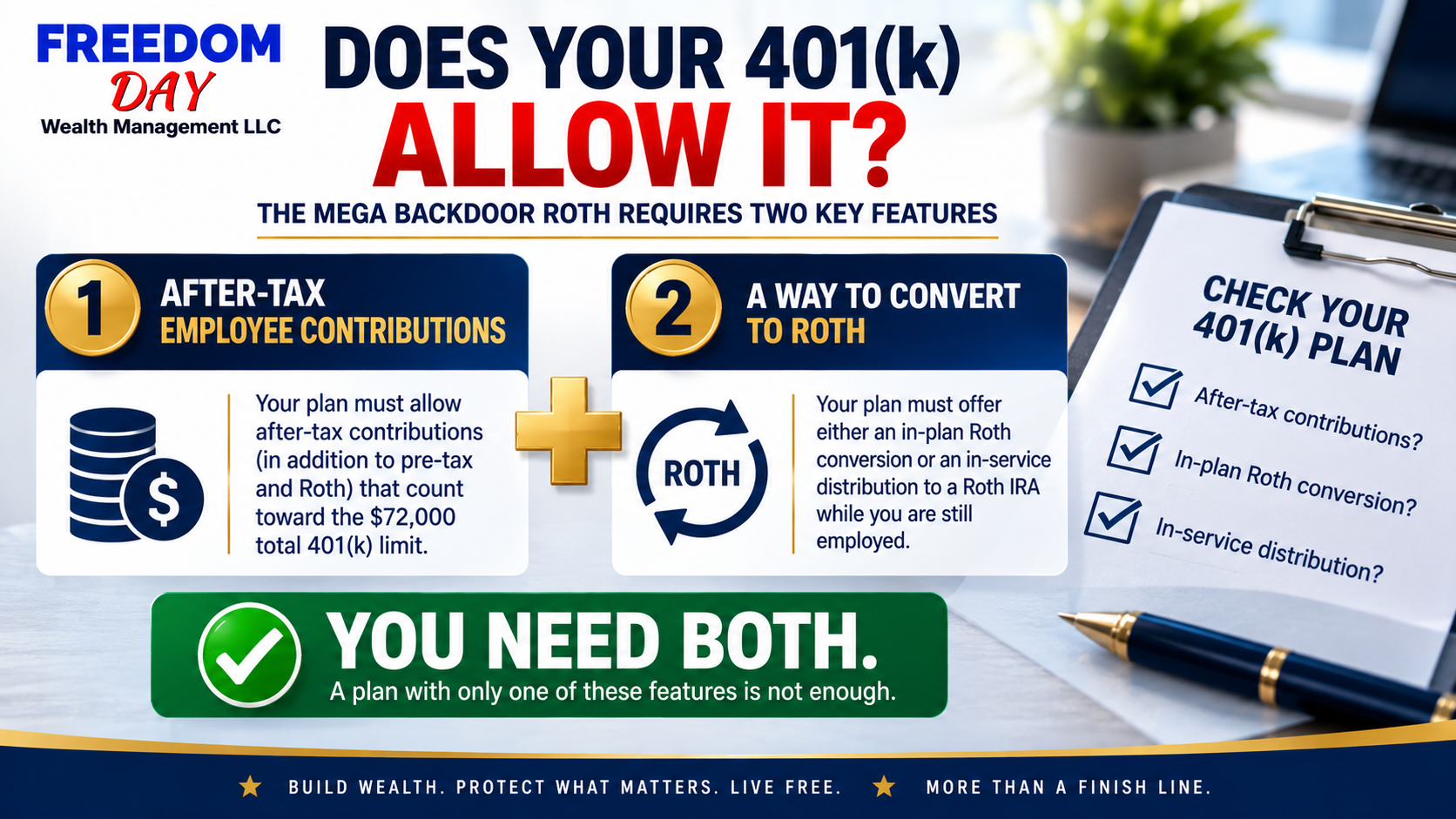
You need both pieces. A plan that permits after-tax contributions but has no conversion mechanism leaves you with money that grows tax-deferred and comes out partly taxable later, which is generally worse than a taxable brokerage account holding index funds. A plan that permits in-plan Roth conversions but has no after-tax source has nothing to convert. Roughly half of large employer plans support the full combination, and it is far more common in tech, so if you are a senior person at a big technology company, there is a reasonable chance it is sitting right there in your benefits portal under a name you have scrolled past a hundred times.
The fastest way to find out is to open your plan's Summary Plan Description and search for the words "after-tax," then search for "in-plan Roth" or "in-service withdrawal." If the language is ambiguous, call the recordkeeper and ask two specific questions: does the plan accept employee after-tax contributions above the deferral limit, and does it allow in-plan Roth conversion or in-service distribution of those after-tax amounts? Ask those two questions exactly, and you will get a clear answer. Ask "Do you offer the mega backdoor Roth," and there is a good chance the person on the phone has no idea what you mean.
One more wrinkle worth knowing. After-tax employee contributions are included in the ACP test, a nondiscrimination test that compares what highly compensated employees contribute against what everyone else contributes. If too few rank-and-file employees use the after-tax feature, the plan can fail the test, and the fix is to refund money to the higher earners after year-end. Some plans manage this by capping after-tax contributions at a percentage of pay well below the theoretical maximum. If your plan tells you you can only contribute 10 percent of pay after tax, that is usually why. It is not a mistake, and it is not negotiable, so plan around the cap rather than fighting it.
How much room do you actually have?
Run the numbers before you decide anything, because the answer is often smaller than the headline suggests. Start with $72,000 for 2026. Subtract your own elective deferrals, whether pre-tax or Roth, which will be $24,500 if you are maxing out. Subtract everything your employer contributes, including the match, any true-up, any profit sharing, and any non-elective contribution. What remains is your theoretical after-tax room, and then you apply whatever percentage-of-pay cap your plan imposes.
A quick hypothetical, and I want to be clear this is an illustration and not a projection of anyone's actual results. Say you earn $400,000 in salary and bonus, you defer the full $24,500, and your company matches 6 percent on the first portion of eligible pay for a total of $14,000. That is $38,500 of the $72,000 consumed, leaving $33,500. If your plan caps after-tax contributions at 10 percent of eligible pay and your eligible pay is $350,000, your cap is $35,000, which is higher than your remaining room, so the 415(c) limit binds and you can do the full $33,500. Change the plan cap to 6 percent, and your ceiling drops to $21,000. Same person, same salary, very different answer, entirely because of plan design.
Two more things go into that calculation. If you are 50 or older, your catch-up contribution doesn't eat into the $72,000, so it doesn't reduce your after-tax room. And if you worked at two employers this year, the $24,500 deferral limit follows you personally across both plans, but the $72,000 limit generally applies per employer for unrelated employers, which occasionally creates more room than people expect.
Is it actually worth doing?
Here is where I want to be honest rather than promotional, because the mega backdoor Roth gets written about as though it is free money, and it is not. It is a real benefit with a real cost, and the cost is liquidity.
The benefit is straightforward, and it compounds. Money in a taxable brokerage account throws off dividends and interest every year that you pay tax on, and for a senior executive that tax is likely at a 20 percent qualified dividend rate plus the 3.8 percent net investment income tax, with ordinary rates on bond interest. Then you pay capital gains when you sell. Money converted to Roth pays none of that, ever, as long as you follow the distribution rules. The gap between those two outcomes over fifteen or twenty years is substantial, and the longer the runway, the bigger it gets.
Roth money also does something specific for people in your situation that has nothing to do with the growth rate. It gives you a pool of retirement income that does not show up as income. That matters more than most people realize once you retire. Required minimum distributions on a large pre-tax 401(k) can push you into a higher bracket in your seventies whether you need the money or not. Medicare premiums are set by IRMAA surcharges based on your modified adjusted gross income from two years prior, and the brackets are cliffs, meaning one dollar of extra income can raise your premium for a full year. Having a Roth bucket you can draw from without generating income is what gives you the ability to manage those thresholds deliberately instead of watching them happen to you.
And for high earners, there is the simple access problem. In 2026, direct Roth IRA contributions phase out between $153,000 and $168,000 of modified adjusted gross income for single filers, and between $242,000 and $252,000 for married couples filing jointly. If you are the executive we are describing, you are well past both. The regular backdoor Roth gets you $7,500. The mega backdoor version can get you five times that or more. For many people, it is the only meaningful way to build Roth assets at this stage of a career.
Now the cost. Once the money goes into the 401(k), it is retirement money. Access before 59 and a half generally means penalties and complications, and even the Roth conversion piece carries its own five-year clock for penalty-free access to converted amounts. If you are planning to retire at 55 and bridge to Social Security, or you might buy a second home, or your kid's tuition is coming, taxable brokerage dollars are the ones you can actually spend without friction. I wouldn't push someone into the last ten thousand dollars of after-tax contributions if it left them short of a comfortable cash position and a taxable account they can access.
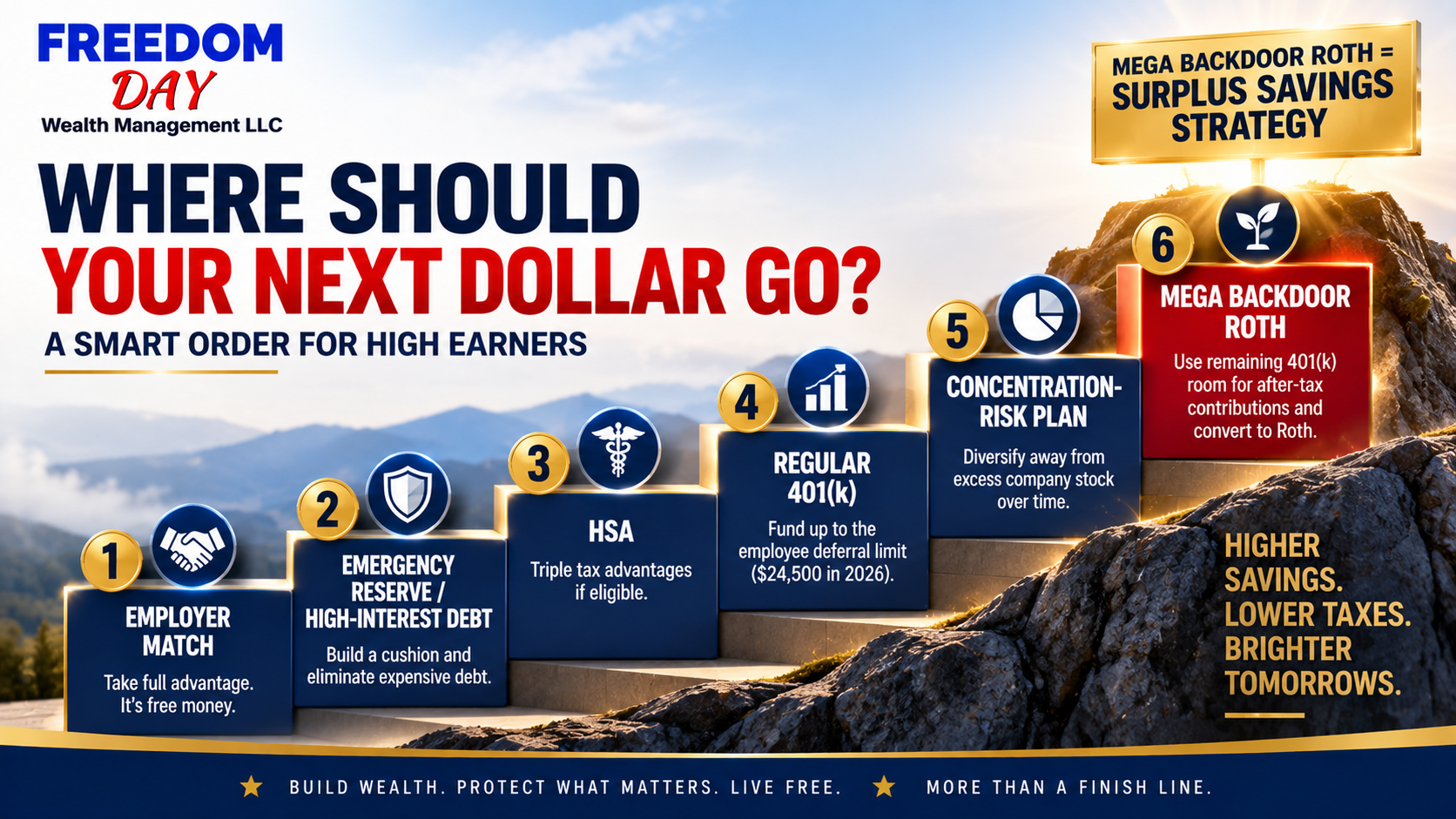
There is also an opportunity cost question that is worth thinking through rather than assuming. If you have a concentrated position in company stock, or high-interest debt, or you are not yet funding an HSA, those may deserve the marginal dollar first. The mega backdoor Roth is a great use of surplus savings. It is not a great use of money that should be solving a bigger problem.
The benefit is straightforward, and it compounds. Money in a taxable brokerage account throws off dividends and interest every year that you pay tax on, and for a senior executive that tax is likely at a 20 percent qualified dividend rate plus the 3.8 percent net investment income tax, with ordinary rates on bond interest. Then you pay capital gains when you sell. Money converted to Roth pays none of that, ever, as long as you follow the distribution rules. The gap between those two outcomes over fifteen or twenty years is substantial, and the longer the runway, the bigger it gets.
Roth money also does something specific for people in your situation that has nothing to do with the growth rate. It gives you a pool of retirement income that does not show up as income. That matters more than most people realize once you retire. Required minimum distributions on a large pre-tax 401(k) can push you into a higher bracket in your seventies whether you need the money or not. Medicare premiums are set by IRMAA surcharges based on your modified adjusted gross income from two years prior, and the brackets are cliffs, meaning one dollar of extra income can raise your premium for a full year. Having a Roth bucket you can draw from without generating income is what gives you the ability to manage those thresholds deliberately instead of watching them happen to you.
And for high earners, there is the simple access problem. In 2026, direct Roth IRA contributions phase out between $153,000 and $168,000 of modified adjusted gross income for single filers, and between $242,000 and $252,000 for married couples filing jointly. If you are the executive we are describing, you are well past both. The regular backdoor Roth gets you $7,500. The mega backdoor version can get you five times that or more. For many people, it is the only meaningful way to build Roth assets at this stage of a career.
Now the cost. Once the money goes into the 401(k), it is retirement money. Access before 59 and a half generally means penalties and complications, and even the Roth conversion piece carries its own five-year clock for penalty-free access to converted amounts. If you are planning to retire at 55 and bridge to Social Security, or you might buy a second home, or your kid's tuition is coming, taxable brokerage dollars are the ones you can actually spend without friction. I wouldn't push someone into the last ten thousand dollars of after-tax contributions if it left them short of a comfortable cash position and a taxable account they can access.
There is also an opportunity cost question that is worth thinking through rather than assuming. If you have a concentrated position in company stock, or high-interest debt, or you are not yet funding an HSA, those may deserve the marginal dollar first. The mega backdoor Roth is a great use of surplus savings. It is not a great use of money that should be solving a bigger problem.