What Is Sequence-of-Returns Risk, and Why It Matters Most Near Retirement
Sequence-of-returns risk is the danger that bad market years hit early in retirement, right when you start pulling money out of your portfolio, and do lasting damage that later good years can't fully repair. Two retirees can earn the exact same average return over twenty years and end up in very different places simply because of the order those returns arrived in. It matters most in the five years before and the five to ten years after you retire, which is why it deserves a spot in your plan long before your last day at work.
What is sequence-of-returns risk?
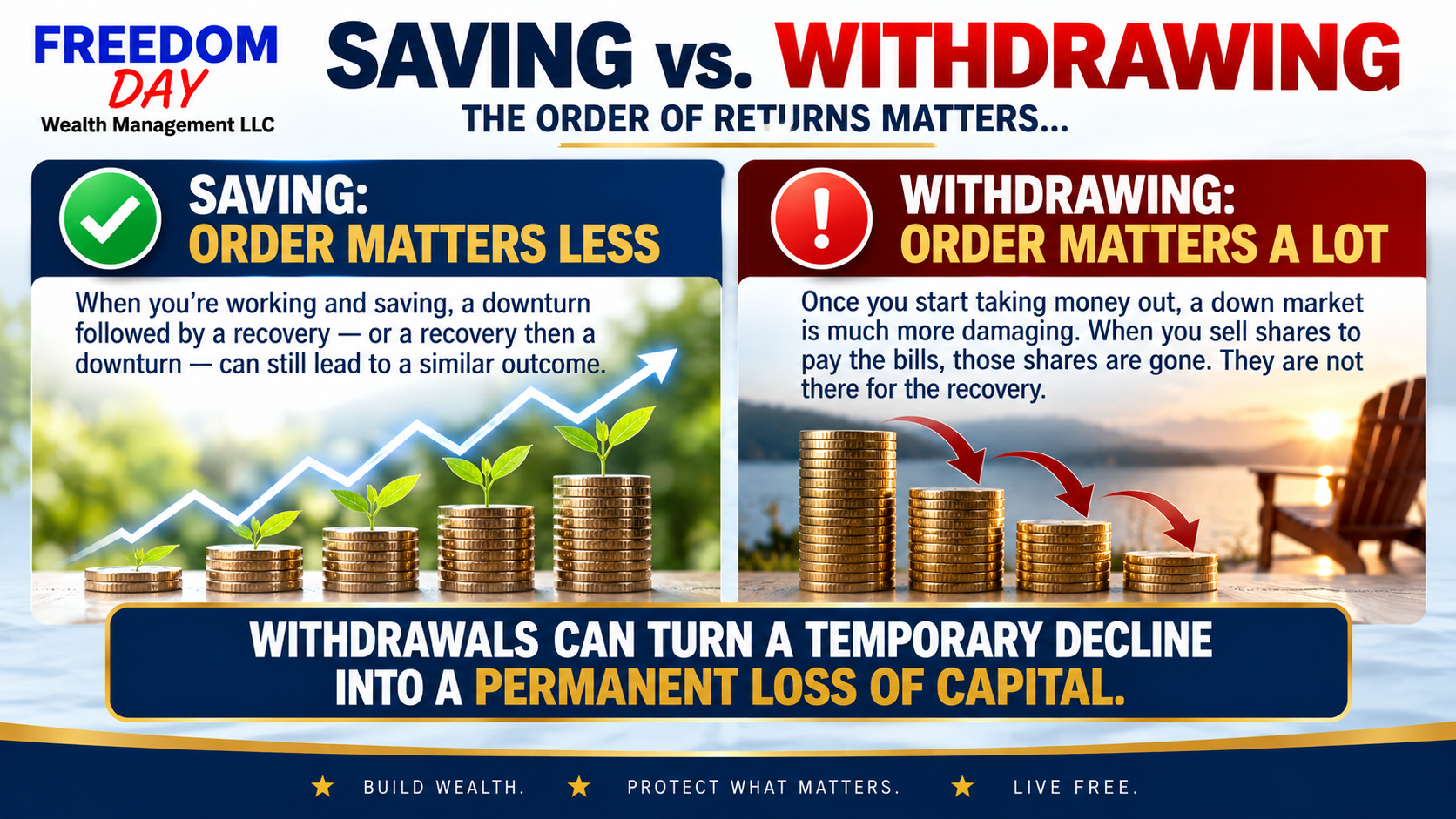
Let me start with the part that surprises people. While you are working and saving, the order of your returns barely matters. If you put a million dollars in the market and never touch it, a crash in year one followed by a recovery lands you in the same place as a recovery followed by a crash. Multiplication does not care about order. Five percent times minus ten percent times twelve percent gives you the same answer, no matter how you line them up.
The moment you start withdrawing money, that stops being true. When the market falls and you sell shares to pay the bills, you sell more shares than you would have at higher prices, and those shares are gone. They are not there to participate in the recovery. The portfolio has to climb back from a smaller base, while you keep taking money out of it every year. That is the whole problem in one sentence: withdrawals turn temporary losses into permanent ones.
Planners call this sequence-of-returns risk, or sequence risk for short. It is not a separate kind of market risk. It is the ordinary ups and downs of the market interacting with the fact that you have switched from putting money in to taking money out. The same volatility that was a buying opportunity during your career becomes a selling problem in retirement.
How much difference can the order of returns really make?
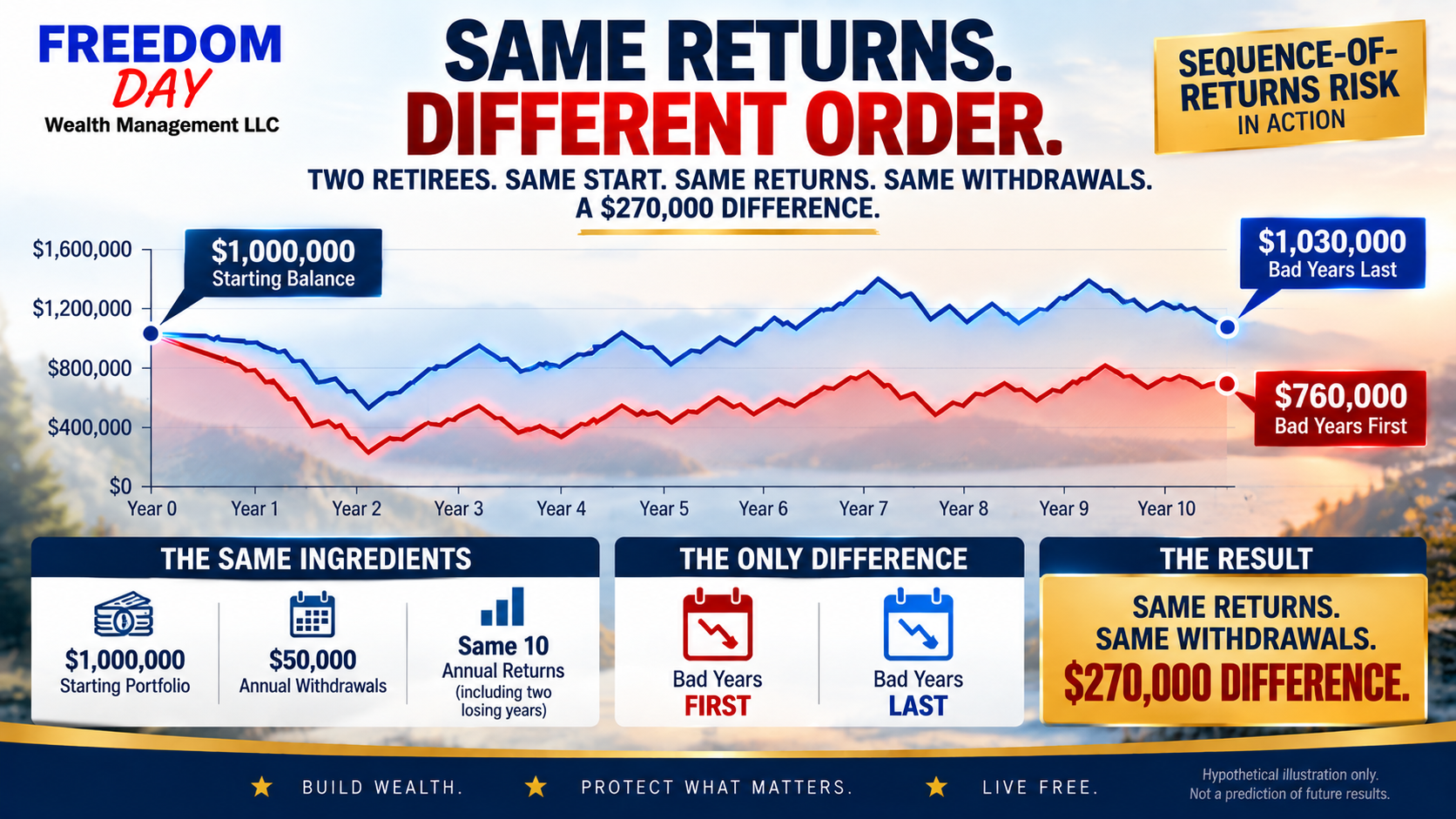
Here is a hypothetical to show the shape of it, and I want to be clear that this is an illustration built on made-up numbers, not a projection or a prediction of anyone's results.
Picture two retirees, each starting with $1,000,000 and each withdrawing $50,000 at the start of every year. Over ten years, both portfolios experience the exact same ten annual returns: minus 15 percent, minus 10 percent, then 5, 8, 10, 12, 9, 7, 11, and 13 percent. The only difference is the order. The first retiree gets those returns in that order, with the two losing years right at the start. The second retiree gets them in reverse, with the good years first and the two losing years at the end.
If neither withdrew a dime, both would finish the decade at about $1,563,000, because order doesn't matter without withdrawals. With the $50,000 annual withdrawals, the retiree who had the bad years last finishes at roughly $1,030,000, still above where they started. The retiree who had the bad years first finishes at roughly $762,000. Same average return, same withdrawals, same ten years, and a gap of more than a quarter of a million dollars that came entirely from timing.
And that gap tends to compound. The first retiree is now withdrawing the same $50,000 from a much smaller pile, which means a higher withdrawal rate on what is left, which means less room for the next rough patch. That is how a plan that looked perfectly safe on paper at 60 can feel tight at 72.
Why does it matter most right around retirement?
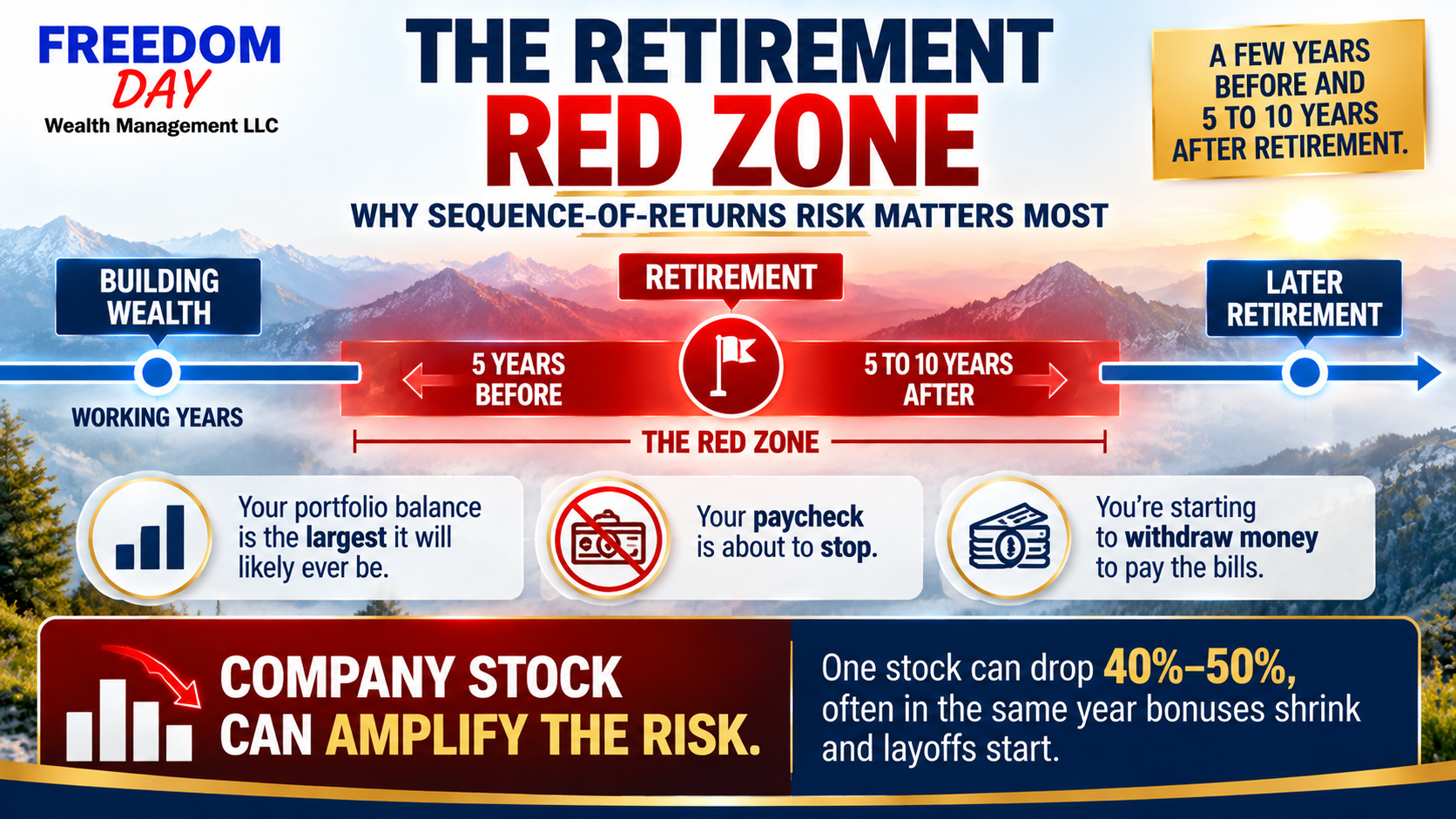
Think of your retirement as having a fragile zone, sometimes called the retirement red zone, that runs from roughly five years before your retirement date to five to ten years after it. Two things are true during that window that are not true at other times.
First, your portfolio is at or near the largest it will ever be. A 20 percent decline on a $3,000,000 balance is a $600,000 swing, and at 45 that same percentage would have been a much smaller dollar amount on a smaller account. Second, you have less time and fewer tools to recover. At 45 you had twenty more years of paychecks, bonuses, and vesting to refill the tank. At 61, with the paychecks stopping, the portfolio is the tank.
A bad year at 75 still stings, but by then your withdrawals have run for a decade, a good part of the plan has already played out, and fewer years of spending are riding on what remains. A bad year at 61 sets the trajectory for everything that follows. That asymmetry is why planners focus so hard on the years right around the transition.
Why are tech executives with equity compensation especially exposed?
For the senior tech executives I work with, sequence risk usually shows up with an extra layer on top, and it is worth naming directly.
The first layer is concentration. Many executives reach the last few years of their career with a large share of their net worth in a single company's stock, built up through restricted stock units, stock options, and the employee stock purchase plan. A single stock can easily fall 40 or 50 percent in a rough year, which is a much bigger drop than a diversified portfolio typically takes. If that decline lands in the year you retire and you are counting on that stock to fund your first few years of spending, you are effectively experiencing sequence risk at double speed.
The second layer is correlation with your paycheck. When the tech sector has a bad year, the stock price, the bonus, the refresh grants, and sometimes the job itself can all go sideways at once. That is exactly when some people get nudged into an earlier retirement than they planned, which means the first withdrawal year arrives in the middle of the worst market year. Planning for that possibility while you still have a salary is far easier than reacting to it after.
The third layer is timing pressure around your exit. Unvested equity, trading windows, 10b5-1 plans, and option expiration dates can all push you to sell or hold at moments that have nothing to do with the market. None of that is a reason to panic. It is a reason to have a diversification plan for company stock that is well underway several years before retirement, not something you start the week you hand in your badge.
How do you protect a retirement plan against sequence risk?
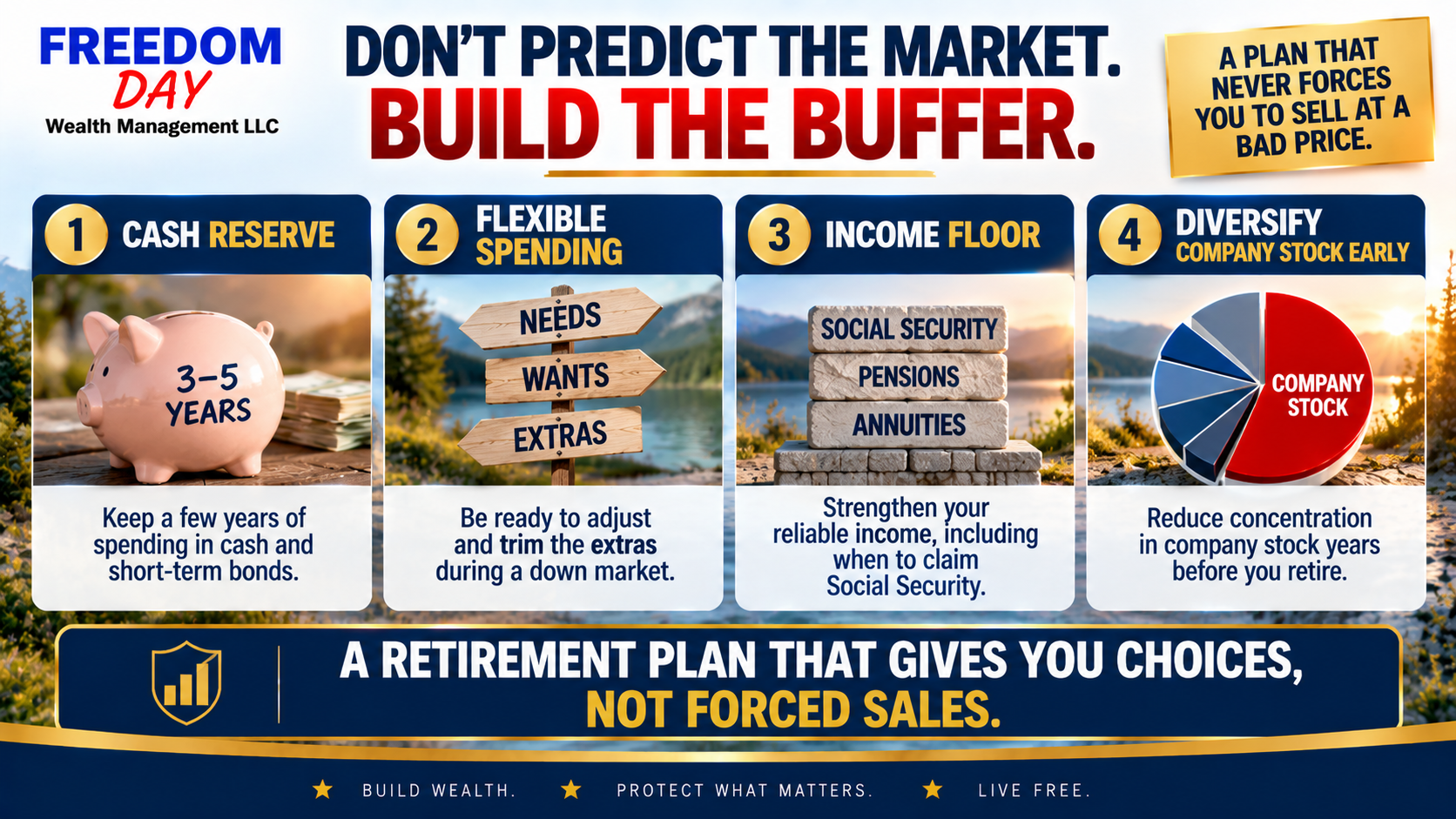
The good news is that sequence risk is one of the most manageable risks in retirement planning, because the solutions are mostly about structure and flexibility rather than prediction. Nobody, including me, knows which year the next downturn will show up. You do not need to. You need a plan that does not force you to sell stocks at a bad price.
Build a cash and short-term bond reserve. The most common approach is to hold enough in cash and high-quality short-term bonds to cover somewhere around two to five years of the spending your portfolio needs to provide, after Social Security, pensions, or other income. When stocks are down, you spend from the reserve and leave the stocks alone to recover. When stocks are up, you refill the reserve from gains. This is the heart of what people call a bucket strategy, and the value is less about maximizing return and more about never being a forced seller.
Consider a gradually shifting allocation around your retirement date. Some planners describe a "bond tent," where your portfolio's bond share rises in the years leading up to retirement, peaks around your retirement date, and then gradually comes back down as you move past the fragile window. The logic is simple: be most conservative exactly when a crash would do the most damage, and let the stock share rebuild once you have made it through.
Build flexibility into your spending. A fixed withdrawal that rises with inflation every year no matter what the market does is the version of retirement most exposed to sequence risk. A plan with guardrails, where you agree ahead of time to trim discretionary spending by a set amount after a bad year and allow a raise after a good one, holds up far better. The cuts rarely need to be dramatic. Postponing a big trip or a car purchase for a year in a down market can meaningfully improve how long the money lasts.
Line up your income floor. The more essential spending you cover with income that doesn't depend on the market, the less you have to sell when the market is down. For most people, that floor starts with Social Security, and delaying your claim increases the monthly benefit for life. A pension, a bond or TIPS ladder, or in some cases an annuity can add to the floor. Each of those has trade-offs worth their own conversation, but the principle is the same: the less your groceries depend on this year's stock market, the less sequence risk can hurt you.
Consider a softer landing. A year or two of part-time consulting, board work, or advisory roles after you leave full-time work can cover a meaningful part of your spending during the most fragile window, and every year you delay withdrawals is a year the portfolio gets to keep compounding.
Diversify company stock before you need it. If a large part of your plan rests on one stock, reducing that concentration over several years, with an eye on taxes, is one of the most direct ways to shrink sequence risk. Methods like planned sales through a 10b5-1 plan, gifting appreciated shares, or timing sales across tax years can all help, and each depends on your specific situation.
Can a down market in early retirement ever work in your favor?
It can, and this is the part that turns sequence risk from something to fear into something to plan around.
If you are in the gap years between retirement and required minimum distributions and you are doing Roth conversions, a down market is often a favorable time to convert. The same number of shares moves to the Roth at a lower value, you pay tax on that lower value, and whatever recovery follows happens inside the Roth where it is never taxed again. Down markets can also create opportunities for tax-loss harvesting in a taxable account and for rebalancing, where you sell some of what held up well and buy more of what fell. None of that makes a bear market pleasant. It does mean a prepared retiree has useful moves available, not just painful ones.
What should you actually do next?
If you are five or more years from retirement, the most useful thing you can do is start shaping the portfolio you want to walk into retirement with. That means planning to reduce company stock concentration over time, building cash and taxable savings outside your retirement accounts, and getting a realistic picture of how much of your spending the portfolio will need to cover versus Social Security and other income.
If you are within two or three years of retirement, this is the moment to get specific. Put a number on your spending reserve, decide what your stock and bond mix should look like on the day you retire and over the following several years, and write down your spending guardrails before you need them. Decisions you make ahead of time are much easier to follow than decisions you make in the middle of a scary market.
If you have already retired, look at where your next two or three years of spending is coming from. If the honest answer is "whatever I sell from the stock portfolio," that is worth fixing while markets are calm rather than after the next decline. As I tell my clients, the goal is not to predict the storm. It is to build the house so that it does not matter much when the storm shows up.
Key takeaways
- Sequence-of-returns risk is the risk that poor market returns early in retirement, combined with withdrawals, permanently shrink your portfolio even if later returns are strong.
- The order of returns does not matter when you are only saving. It matters a lot once you start withdrawing, because shares sold at low prices are not there for the recovery.
- In a hypothetical ten-year example with identical average returns and $50,000 annual withdrawals from $1,000,000, the retiree with losses first ended about $270,000 behind the retiree with losses last.
- The most fragile window is roughly five years before to five to ten years after your retirement date, when balances are largest and recovery time is shortest.
- Executives with concentrated company stock face amplified sequence risk, because a single stock can fall much further than a diversified portfolio and often at the same time as bonuses and jobs are under pressure.
- Practical defenses include a cash and short-term bond reserve, a gradually shifting allocation around retirement, flexible spending guardrails, a stronger income floor, and diversifying company stock well before you need the money.
- Down markets in early retirement can create opportunities for Roth conversions, tax-loss harvesting, and rebalancing when you are prepared.
Frequently asked questions
Is sequence-of-returns risk the same thing as market risk? Not exactly. Market risk is the possibility that investments lose value. Sequence risk is what happens when those losses arrive at the same time you are withdrawing money. A long-term saver who is not withdrawing is exposed to market risk but not really to sequence risk, because they are not being forced to sell at low prices.
How many years of spending should I keep in cash or short-term bonds? Many planners use somewhere between two and five years of the spending the portfolio needs to cover, meaning after Social Security and other income. More reserve means more protection but a bit less long-term growth, so the right number depends on your spending, your other income, and how you would feel watching the stock portion drop 30 percent. It is worth modeling rather than guessing.
Does the 4 percent rule already account for sequence risk?
The research behind the 4 percent rule was built from historical return sequences, including some very bad ones, so it does reflect sequence risk in that sense. It also assumes rigid, inflation-adjusted withdrawals and a specific portfolio mix, which is not how most people actually spend. A plan with flexible spending and a cash reserve can often handle sequence risk better than a fixed rule. We will dig into safe withdrawal rates in a separate article.
If I am worried about sequence risk, should I just move everything to bonds when I retire? Usually not. A retirement can easily last 30 years or more, and a portfolio with too little in stocks faces a different risk: running short because it did not grow enough to keep up with inflation. The more common approach is to be most conservative right around your retirement date and then let the stock share rebuild over time, rather than going all-in on either side.
Can an annuity help with sequence risk? It can, because a lifetime income annuity converts part of your savings into guaranteed income that doesn't depend on market returns, strengthening your income floor. Annuities also come with costs, reduced flexibility, and a wide range of product quality, so evaluate them carefully in the context of your whole plan rather than as a stand-alone fix.
What if I get laid off or pushed into early retirement during a bad market? That is exactly the scenario sequence planning is designed for. A cash reserve, a diversified portfolio rather than a concentrated company stock position, and a written plan for what you would cut or change in a down year give you options. If you are still working, building those pieces now is much easier than building them after a surprise.
About Jeff Kikel
Jeff Kikel is the President and Chief Investment Officer of Freedom Day Wealth Management, a fee-based wealth and retirement planning firm that helps senior professionals and executives turn a career's worth of equity compensation and savings into a confident, well-planned retirement. Jeff writes and speaks in plain language because he believes people make better decisions when they actually understand what is happening with their money. His approach is simple: explain the tradeoffs honestly, keep the focus on the long term, and always circle back to what you should actually do next.
If you are getting close to retirement and want to make sure a bad market in the first few years cannot derail your plan, Freedom Day Wealth Management can help you map it out alongside your equity compensation and your retirement timeline. You can learn more at
www.FreedomDayWealth.com.
Sources:
- Schwab: What Is Sequence-of-Returns Risk?
- Kitces: The Portfolio Size Effect and Using a Bond Tent
- Morningstar: What's a Safe Retirement Withdrawal Rate for 2026?
- Morningstar: Reevaluating the 4% Withdrawal Rule
- SSA: Delayed Retirement Credits
This article is for educational purposes only and is not investment, tax, or legal advice. Every situation is different, and the rules and dollar limits referenced here can change. Please consult a qualified financial or tax professional, and review your own plan documents, before making decisions about your retirement withdrawals and investment allocation.
Investment Services provided by Freedom Day Wealth Management, LLC, a Registered Investment Advisor. FDWM has agents licensed to sell Life insurance and related products in TX, AZ, and CO.